

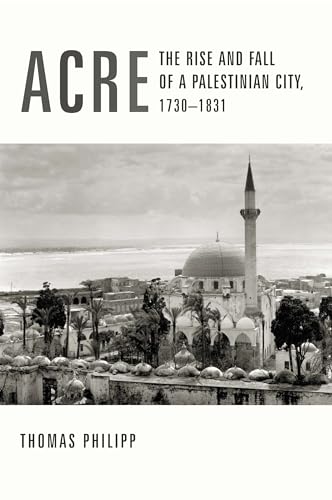
Acre : The Rise and Fall of a Palestinian City, 1730-1831 / Thomas Philipp.
Material type: TextSeries: History and Society of the Modern Middle EastPublisher: New York, NY : Columbia University Press, [2002]Copyright date: ©2002Description: 1 online resource (208 p.) : 9 graphs, 8 mapsContent type:
 - 9780231123266
- 9780231506038
- online - DeGruyter
- Issued also in print.
| Item type | Current library | Call number | URL | Status | Notes | Barcode | |
|---|---|---|---|---|---|---|---|
 eBook
eBook
|
Biblioteca "Angelicum" Pont. Univ. S.Tommaso d'Aquino Nuvola online | online - DeGruyter (Browse shelf(Opens below)) | Online access | Not for loan (Accesso limitato) | Accesso per gli utenti autorizzati / Access for authorized users | (dgr)9780231506038 |
Frontmatter -- Contents -- Acknowledgments -- Introduction -- 1. Southwest Syria in the Eighteenth Century: Highways, Sea Lanes, and Populations -- 2. The Politics of Acre -- 3. Trade:Local Rulers and the World Economy -- 4. Government:Th e Military and Administration -- 5. Society and Its Structure in Acre -- Concluding Observations -- APPENDIX A. The Population of Acre -- APPENDIX B. Trade: Tables and Figures -- APPENDIX C. Administrative Positions and Their Occupants -- APPENDIX D. Maps -- Notes -- Translations -- Bibliography -- Index
restricted access online access with authorization star
http://purl.org/coar/access_right/c_16ec
Thomas Philipp's study of Acre combines the most extensive use to date of local Arabic sources with commercial records in Europe to shed light on a region and power center many identify as the beginning of modern Palestinian history. The third largest city in eighteenth-century Syria-after Aleppo and Damascus-Acre was the capital of a politically and economically unique region on the Mediterranean coast that included what is today northern Israel and southern Lebanon. In the eighteenth century, Acre grew dramatically from a small fishing village to a fortified city of some 25,000 inhabitants. Cash crops (first cotton, then grain) made Acre the center of trade and political power and linked it inextricably to the world economy. Acre was markedly different from other cities in the region: its urban society consisted almost exclusively of immigrants seeking their fortune. The rise and fall of Acre in the eighteenth and nineteenth centuries, Thomas Philipp argues, must be seen against the background of the decay of central power in the Ottoman empire. Destabilization of imperial authority allowed for the resurfacing of long-submerged traditional power centers and the integration of Arab regions into European and world economies. This larger imperial context proves the key to addressing many questions about the local history of Acre and its peripheries. How were the new sources of wealth and patterns of commerce that remade Acre reconciled with traditional forms of political power and social organization? Were these forms really traditional? Or did entirely new classes develop under the circumstances of an immigrant society and new commercial needs? And why did Acre, after such propitious beginnings as a center of export trade and political and military power strong enough to defy Napoleon, give way to the dazzling rise of Beirut in the nineteenth century? For centuries the object of the Crusader's fury and the trader's envy, Acre is here restored to its full significance at a crucial moment in Middle Eastern history.
Issued also in print.
Mode of access: Internet via World Wide Web.
In English.
Description based on online resource; title from PDF title page (publisher's Web site, viewed 02. Mrz 2022)