

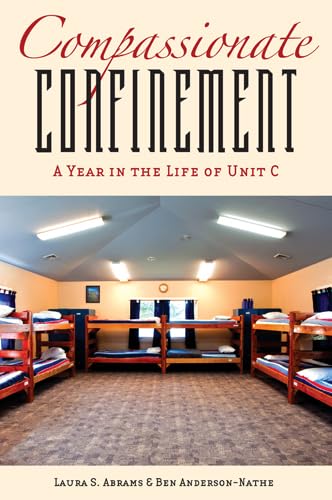
Compassionate Confinement : A Year in the Life of Unit C / Ben Anderson-Nathe, Laura S. Abrams.
Material type: TextSeries: Critical Issues in Crime and SocietyPublisher: New Brunswick, NJ : Rutgers University Press, [2013]Copyright date: ©2013Description: 1 online resource (188 p.)Content type:
 - 9780813554129
- 9780813554143
- 365.420973
- HV9104 .A27 2012
- online - DeGruyter
- Issued also in print.
| Item type | Current library | Call number | URL | Status | Notes | Barcode | |
|---|---|---|---|---|---|---|---|
 eBook
eBook
|
Biblioteca "Angelicum" Pont. Univ. S.Tommaso d'Aquino Nuvola online | online - DeGruyter (Browse shelf(Opens below)) | Online access | Not for loan (Accesso limitato) | Accesso per gli utenti autorizzati / Access for authorized users | (dgr)9780813554143 |
Frontmatter -- Contents -- Foreword -- Acknowledgments -- Introduction -- Chapter 1. History and Current Tensions in Juvenile Corrections -- Chapter 2. The Setting -- Chapter 3. Mixed Messages: "Therapy Speak" in a Correctional Milieu -- Chapter 4. "Take It Like a Man": Masculinities, Treatment, and Crime -- Chapter 5. "Jumping through Hoops": Identity, Self-Preservation, and Change -- Chapter 6. On the Outs -- Chapter 7. Rehabilitating Rehabilitation: What We Learned from Unit C -- Appendix: Behind the Scenes: Reflections on Field Research in Action -- References -- Index -- About the Author
restricted access online access with authorization star
http://purl.org/coar/access_right/c_16ec
To date, knowledge of the everyday world of the juvenile correction institution has been extremely sparse. Compassionate Confinement brings to light the challenges and complexities inherent in the U.S. system of juvenile corrections. Building on over a year of field work at a boys' residential facility, Laura S. Abrams and Ben Anderson-Nathe provide a context for contemporary institutions and highlight some of the system's most troubling tensions. This ethnographic text utilizes narratives, observations, and case examples to illustrate the strain between treatment and correctional paradigms and the mixed messages regarding gender identity and masculinity that the youths are expected to navigate. Within this context, the authors use the boys' stories to show various and unexpected pathways toward behavior change. While some residents clearly seized opportunities for self-transformation, others manipulated their way toward release, and faced substantial challenges when they returned home. Compassionate Confinement concludes with recommendations for rehabilitating this notoriously troubled system in light of the experiences of its most vulnerable stakeholders.
Issued also in print.
Mode of access: Internet via World Wide Web.
In English.
Description based on online resource; title from PDF title page (publisher's Web site, viewed 30. Aug 2021)